
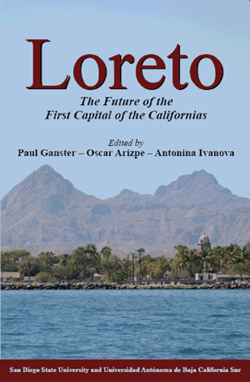
cover
About the Book
Loreto: The Future of the First Capital of the Californias / El Futuro de la Primera Capital de las Californias is a deliberately binational portrait of one of the most historically resonant and environmentally fragile communities on the Baja California peninsula. Edited by Paul Ganster, Oscar Arizpe, and Antonina Ivanova, the 2007 volume brings together 17 essays by scholars and practitioners from Mexico and the United States to ask a deceptively simple question: what kind of future should Loreto build on the foundations of its extraordinary past?
Loreto was the first enduring Jesuit mission settlement in the Californias and the political and religious center from which the mission frontier expanded northward. But this book is not content to monumentalize that history. Its real subject is a living community entering a period of intense twenty-first-century pressure: tourism development, population growth, scarce water and energy resources, coastal and marine conservation, changing local economies, and the difficult work of protecting quality of life while new investment reshapes the region.
The volume moves across six broad territories: natural resources and environment; history, society, and culture; economy and regional development; tourism; government and quality of life; and the challenges ahead. That range makes Loreto something more useful than either a conventional local history or a development report. Historical essays sit beside research on marine and coastal ecosystems, renewable energy, economic structure, tourism, governance, community wellbeing, and the choices facing a small city whose landscape and cultural identity are themselves economic assets.
Its bilingual form is part of the argument. The book was produced through collaboration between San Diego State University and the Universidad Autónoma de Baja California Sur, with researchers, students, independent scholars, and practitioners from both sides of the border. Rather than studying Loreto from afar, the project was designed to create a shared baseline of information that local residents, researchers, public officials, and planners could use while debating the region’s future.
A Binational Research Project
The project grew from collaboration between SDSU and the Coastal Systems Ecology Laboratory at the Universidad Autónoma de Baja California Sur. Research meetings in San Diego, La Paz, and Loreto helped define the central questions, identify contributors, and shape the interdisciplinary structure of the book. From the beginning, the editors understood that Loreto was entering a new and unusually consequential phase as development pressures accelerated across Baja California Sur.
The result is a snapshot taken at a hinge moment. The book records what Loreto possessed—historically, socially, economically, and ecologically—before large-scale tourism and development could make those conditions harder to reconstruct. That baseline has given the volume a second life: later scholarship on Loreto repeatedly returns to the 2007 collection when measuring what changed, what endured, and which warnings proved prescient.
From Sea Turtles to Tourism
The breadth of the collection is visible in its subjects. One chapter examines Loreto Bay as habitat for sea turtles and considers conservation alongside ecotourism and local cultural practices. Other contributions address marine and coastal flora and fauna, energy demand and renewable resources, economic development, social and cultural history, tourism, government, and quality of life. The cumulative effect is to insist that Loreto cannot be understood by separating its economy from its environment—or its future from its past.
A companion planning study, Alternative Futures for the Region of Loreto, appeared in 2005 through a U.S.–Mexican university partnership. The 2007 Loreto volume deepened that conversation with historical, scientific, social, and economic research. A later SDSU Press volume, Loreto, Mexico: Challenges for a Sustainable Future, explicitly tells readers to read the newer work together with this earlier collection, treating the 2007 book as the baseline against which subsequent development and sustainability challenges can be understood.
A Book That Entered the Conversation
The book did not disappear into a library shelf after publication. The Ocean Foundation has described it as a widely used book on Loreto’s history and community, and individual chapters continue to circulate in environmental, tourism, historical, and regional-studies scholarship. Its continuing usefulness comes from the editors’ original wager: before arguing over how Loreto should grow, assemble enough shared knowledge to understand what is actually at stake.