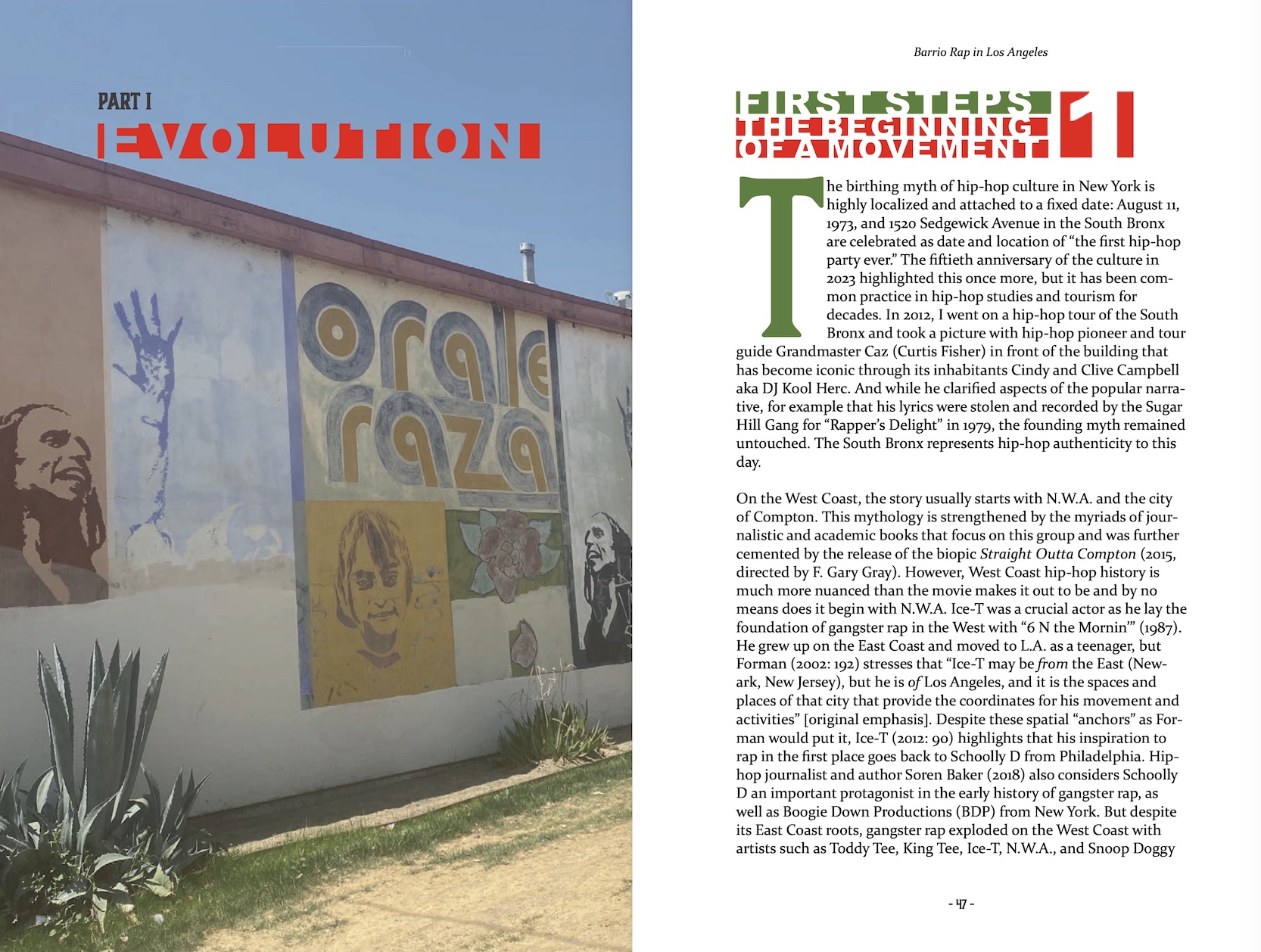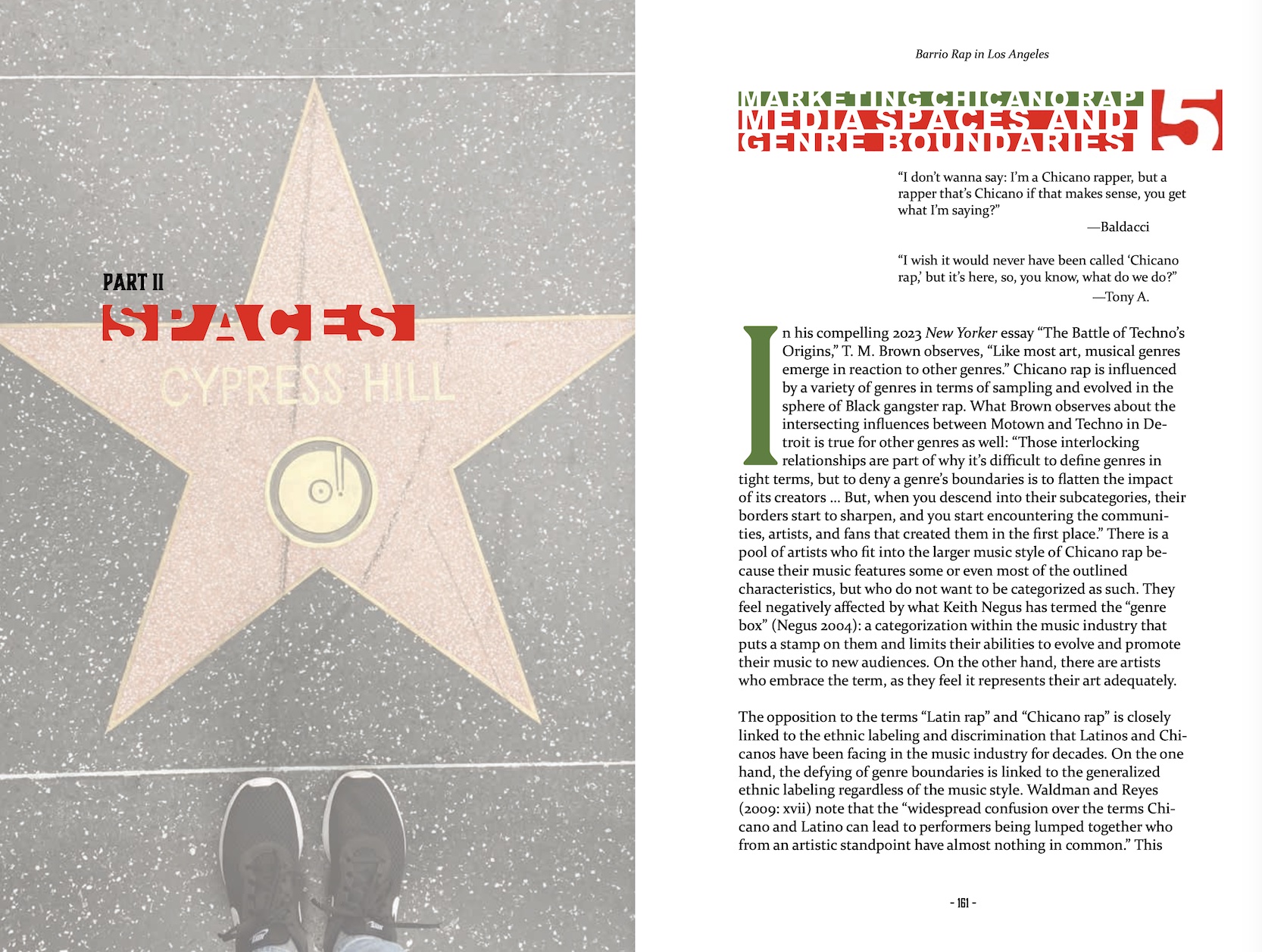

front cover — click to enlarge
Born in the barrios of Los Angeles and circulating across streets, studios, and platforms, barrio rap has always been hypervisible and under-theorized. In this immersive, field-driven study, Dianne Violeta Mausfeld brings together ethnography and cultural studies to trace a music culture shaped by Mexican American life, transnational flows, digital mediation, and urban precarity.
Drawing on long-term fieldwork, oral history, and close readings of lyrics, performances, and social media, Mausfeld reframes barrio rap not as a derivative subgenre but as a site of cultural production where identity is negotiated through sound, style, and place. Engaging concepts of hybridity, flow, mediascapes, and affect, the book tracks how artists move between the local and the global, the analog and the digital, the archive and the feed.
From DIY studios and informal economies to Instagram as living archive, Barrio Rap in Los Angeles shows how music operates as spatial practice, counter-archive, and mode of belonging in a city structured by racial capitalism, surveillance, and displacement. Mausfeld's reflexive methodology foregrounds positionality, collaboration, and ethical ethnography, offering a model for research conducted with communities rather than merely about them.
At once theoretically agile and narratively alive, Barrio Rap in Los Angeles speaks to scholars of hip-hop studies, Latinx and Chicanx studies, urban studies, media studies, and ethnomusicology. It insists that the barrio is not marginal to American culture—but central to how culture is made, circulated, and felt in the twenty-first century.
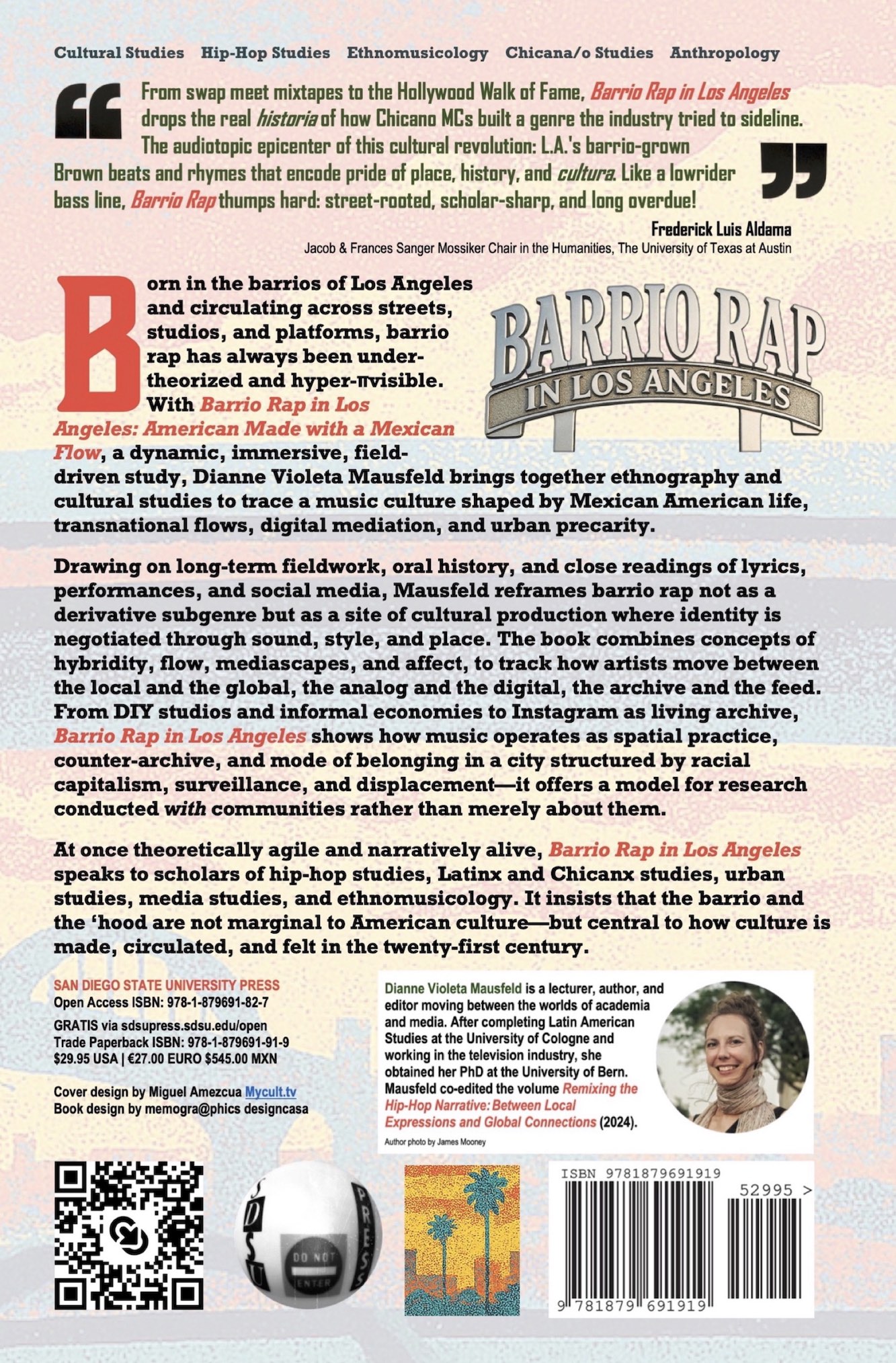
back cover — click to enlarge
About the Author

Dr. Dianne Violeta Mausfeld (@VioleMaDee) is a historian of hip-hop cultures and the Mexican American diaspora, working at the intersection of archives, barrios, and basslines. Her research traces how Chicano rap and broader hip-hop cultures circulate across the Americas, where Caribbean, Latino, and African American sonic worlds remix history, memory, and identity.
She earned her PhD in History from the University of Bern (2022) and is an Associated Researcher in Iberian and Latin American History there, as well as at the Center for InterAmerican Studies at Bielefeld University, where she has held a postdoc fellowship and continues as affiliated faculty.
Her work is grounded in extensive fieldwork in Los Angeles and San Diego, alongside archival research at major hip-hop and cultural collections including Rice University, the University of Houston, UCLA, Cornell, and the Schomburg Center in New York. A Hamburg native based in Cologne since 2006, Mausfeld also has a background in Latin American Studies and television editing. Her work appears in journals and edited volumes, including Remixing the Hip Hop Narrative (2024).
Advance Word
“Dianne Violeta Mausfeld's Barrio Rap is an amazing historical cruise that describes the rise and evolution of the distinctive Los Angeles Chicano hip-hop scene in meticulous detail. It illuminates critical moments, cultural politics, style and fashion, and media forms behind the culture and introduces many of the key OG players who created rap en el barrio.
Clear and rigorously analytical on every page, this is top-shelf, original scholarship and a most welcome addition to global hip-hop studies.”Murray Forman — author of The 'Hood Comes First: Race, Space, and Place in Rap and Hip-Hop
“An indispensable addition to the history of hip hop in Los Angeles, Barrio Rap offers a rich account of the musical lives and artistic contributions of Latino hip hop artists in the City of Angels. Mausfeld's extensive interviews lend nuance to an under-explored area of hip hop history, revealing a multiethnic and multiracial network of artistic creators and collaborators.”Amy Coddington — author of How Hip Hop Became Hit Pop: Radio, Rap, and Race