
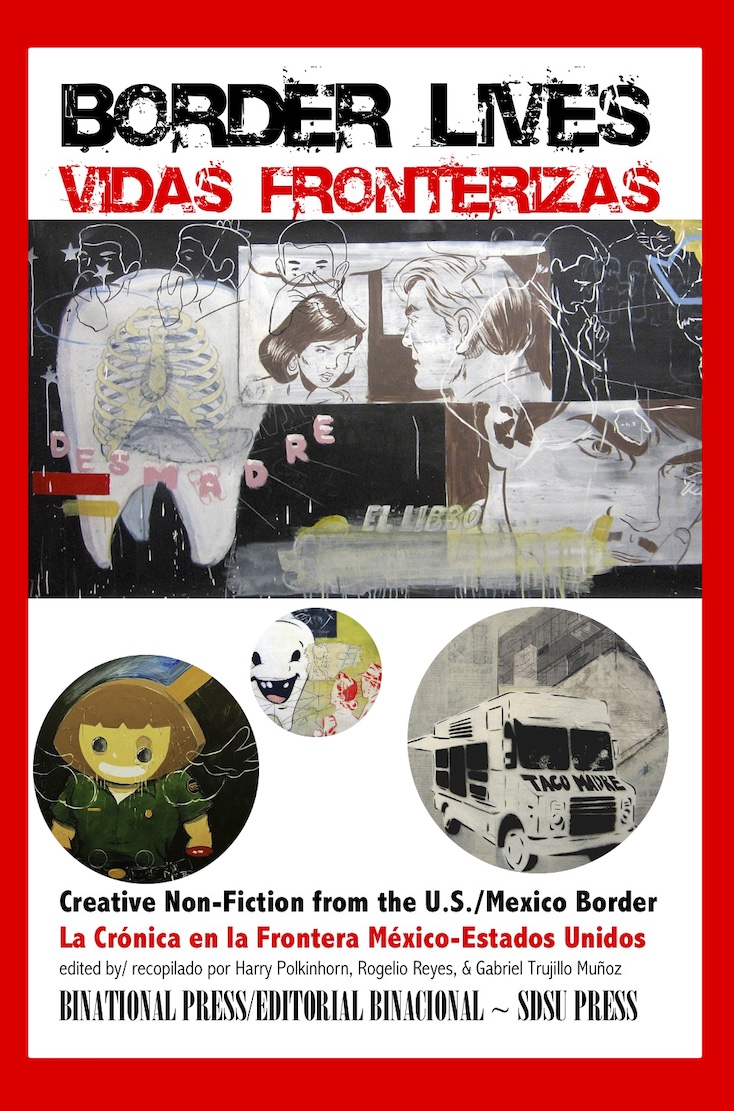
About the Book
Border Lives / Vidas Fronterizas is one of the most expansive books produced by the Binational Press / Editorial Binacional experiment: ten personal essays and crónicas, each presented in both English and Spanish, using the elasticity of creative nonfiction to register what it feels like to live inside the cultural, political, economic, and psychic traffic of the U.S.-Mexico borderlands. Rather than treating the border as a clean line on a map, the volume approaches it as a lived condition—unstable, contradictory, intimate, and constantly renegotiated.
The essays move between memoir, travel writing, cultural criticism, autobiography, history, performance, and journalistic observation. That mixture is central to the book's argument. In his opening discussion of the essay form, Harry Polkinhorn describes a genre capable of joining philosophical meditation, travel impressions, character sketch, autobiographical reference, and observation. Border Lives puts that hybridity to work on a region where identity itself is often hybrid: where language, nationality, class, ethnicity, memory, and place refuse to stay politely separated.
The contributors are James Bradley, David Clayton, José Manuel Di Bella, Carlos Fabián Saravia, Emily Hicks, Ramona Mejía, William A. Nericcio, Harry Polkinhorn, Leobardo Saravia Quiroz, and Gabriel Trujillo Muñoz. Their essays do not offer a single theory of border life. Instead they accumulate sharply different forms of testimony. Gabriel Trujillo Muñoz revisits youth in northern Mexico and his coming-of-age as a rock-and-roll-loving medical student in Jalisco; William A. Nericcio worries the unstable relationship between memory and truth while moving between Laredo and San Diego; Emily Hicks turns personal rupture, betrayal, breakdown, motherhood, and performance into a collage-like narrative; James Bradley folds family and personal memory into a larger reckoning with U.S. political and military power in Mexico and Central America. A later SDSU Press meditation on the volume also singles out Ramona Mejía's vivid, Lotería-like imaginative structure as another example of the book's refusal of conventional autobiographical form.
What binds these disparate pieces together is not agreement but friction. The collection repeatedly returns to the disorientation of border existence: competing histories, mobile identities, bilingual and bicultural codes, extreme economic disparities, political slogans, popular culture, religion, memory, migration, and the everyday struggle to answer deceptively simple questions such as where one comes from and what it means to belong. The result is less a survey of the border than a set of intensely situated encounters with it.
Published in 1995 as the seventh volume in the Binational Press border series, this illustrated 680-page book is also a material record of the press's bilingual mission. English and Spanish versions sit beside one another across the collection, making translation part of the reading experience rather than an afterthought. In that sense, Border Lives embodies the larger SDSU/UABC project: border writing produced through border collaboration.
From the SDSU Press archive: this expanded description draws on the Press's 2011 feature “You Know Where You Are Now: A Look Inside Border Lives”, its 2011 post showing covers and interior page scans, and the 2013 feature “Vidas Fronterizas: Creative Non-Fiction from the U.S./Mexico Border”.
Inside Border Lives
The SDSU Press blog archive preserves a useful visual afterlife of the book: cover images, page scans, and glimpses into the essays by William A. Nericcio and D. Emily Hicks. Rather than reproducing low-resolution Blogger assets here and risk broken hotlinks, the links below take readers directly to the original Press posts where those scans remain in their archival context.