
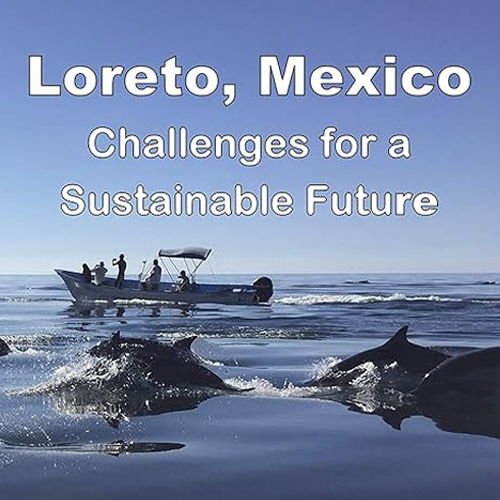
cover · click to enlarge
About the Book
Loreto, Mexico: Challenges for a Sustainable Future returns to a place SDSU Press and the Institute for Regional Studies of the Californias had studied intensively more than a decade earlier and asks the harder follow-up question: what happened next? Edited by Paul Ganster, Oscar Arizpe C., and Vinod Sasidharan, the 2020 volume brings together thirteen chapters on Loreto's history, natural environment, economy, tourism, governance, infrastructure, fisheries, water, climate vulnerability, and the development pressures that now converge on one of Baja California Sur's most distinctive communities.
The book is deliberately unsentimental about the word sustainable. Loreto's extraordinary landscape and marine environment are the basis of much of its appeal, but they are also under pressure from competing forms of development. The contributors examine mass tourism and resort planning, scarce and overdrawn freshwater supplies, the energy demands of a growing community, small-scale fishing, the Bahía de Loreto National Park, and proposed mining activity whose water use, waste, and visual footprint could collide directly with the region's conservation and tourism economy.
Climate change sharpens nearly every one of those tensions. The volume considers higher temperatures, reduced rainfall, drought, flooding, sea-level rise, aquifer recharge, and the difficult question of how local institutions can move from identifying vulnerabilities to actually implementing adaptation. Its argument is practical rather than apocalyptic: Loreto has options, but those options require community participation, stronger public administration, better planning, and coordination across municipal, state, and federal levels.
This is also a sequel in the strongest sense. The editors explicitly ask readers to read the book alongside the 2007 SDSU Press/UABCS collection Loreto: The Future of the First Capital of the Californias. The earlier volume established a binational baseline at a moment of accelerating development; the 2020 book revisits the same region after another decade of tourism growth, environmental stress, and policy experience. Read together, the two books become a longitudinal portrait of a community negotiating how much change its ecology, infrastructure, economy, and cultural identity can absorb.
Thirteen Ways into Loreto's Future
The book's thirteen chapters refuse to isolate "environment" from everyday life. History leads into the marine park; governance into electricity; economic wellbeing into tourism; fishing into diversification; heritage routes into alternative tourism; climate change into mining and water. The final chapter brings those strands together under a deliberately unsettled title: "Loreto: The Uncertain Road Ahead."
- Loreto through the Centuries — Paul Ganster
- Bahía de Loreto National Park — Oscar Arizpe C. & Mario Verdugo Partida
- Structure and Function of Local Government in Loreto — Alberto Torres García, Plácido Cruz Chávez & Judith Juárez Mancilla
- Electric Power in Loreto — Alfredo Bermúdez-Contreras, Pedro Daniel Molina-Pfennig & Omar Castro López
- Economic Structure, Wellbeing, and Tourism Alternatives in Loreto — Manuel Ángeles, Alba E. Gámez & Eduardo Juárez León
- Traditional and Alternative Tourism in Loreto — Judith Juárez Mancilla, Plácido Cruz Chávez, Alberto Torres García & Adilene Sarahí Espinoza Castillo
- Small-Scale Fishing and Economic Diversification in Loreto — Miguel Ángel Ojeda Ruiz de la Peña, Miguel Humberto Armenta-Cisneros & Oscar Trujillo-Millán
- El Camino Real de las Californias: Alternative Tourism Opportunities for Loreto — Paul Ganster & Javier Gaitán-Morán
- Sustainable Tourism Development in Loreto: Community Perspectives — Vinod Sasidharan, José T. Olague de la Cruz & Marisa Reyes-Orta
- Climate Change and Vulnerability in Loreto — Arturo González-Baheza, Mario Verdugo Partida & Oscar Arizpe C.
- Mining Development: Costs and Benefits for Loreto — Ernesto Ramos Velázquez, Alejandro Álvarez Arellano, Gustavo Cruz Chávez & Alberto Torres García
- Water Resources of Loreto — Jobst Wurl & Arturo González-Baheza
- Loreto: The Uncertain Road Ahead — Paul Ganster, Oscar Arizpe C. & Vinod Sasidharan
The Pressure Points
Water. Loreto's aquifers have been under pressure for decades, while tourism is unusually water-intensive. The book examines leakage, groundwater recharge, drought, possible desalination, and the equity problem created when visitor infrastructure and local households compete for a finite supply.
Tourism. Loreto's economy depends heavily on visitors, but the contributors distinguish small-scale, cultural, nature-based, and community-oriented tourism from the megaproject model associated with other Mexican coastal destinations. The question is not whether tourism matters; it is which forms of tourism can support local wellbeing without consuming the qualities that make Loreto valuable.
Mining and climate. Proposed gold, silver, and copper development northwest of Loreto raises questions about water demand, mine waste, contamination, viewsheds, and compatibility with the protected marine environment and tourism economy. At the same time, climate projections intensify heat, drought, flooding, and water-supply risks. The book treats these not as separate crises but as overlapping planning problems.
From the Aztec Paper Archive
SDSU Press introduced the book on Aztec Paper in June 2020 by foregrounding the collision among mass tourism, mining, scarce freshwater, climate change, and public administration. The post also profiles the editors: coastal-systems ecologist Oscar Arizpe C.; IRSC director and border-regions scholar Paul Ganster; and SDSU tourism scholar Vinod Sasidharan, whose work includes sustainable, cultural, grassroots, and ecotourism.
Two months later, SDSU Press editorial associate David Ornelas interviewed Oscar Arizpe about why Loreto's sustainability problems matter beyond Loreto itself—an apt companion to a book whose central questions cross disciplinary and national borders.
Read the June 2020 launch post · Read the August 2020 Oscar Arizpe interview
The Loreto Books Together
The 2020 editors tell readers to use this volume in concert with Loreto: The Future of the First Capital of the Californias (2007). That earlier bilingual collection assembled seventeen essays and a baseline of knowledge at the beginning of a new development cycle. This book returns after thirteen years with new data and sharper pressures. Together they document not merely Loreto as a place, but Loreto as an ongoing experiment in whether historical identity, community wellbeing, tourism, and ecological limits can be planned together.